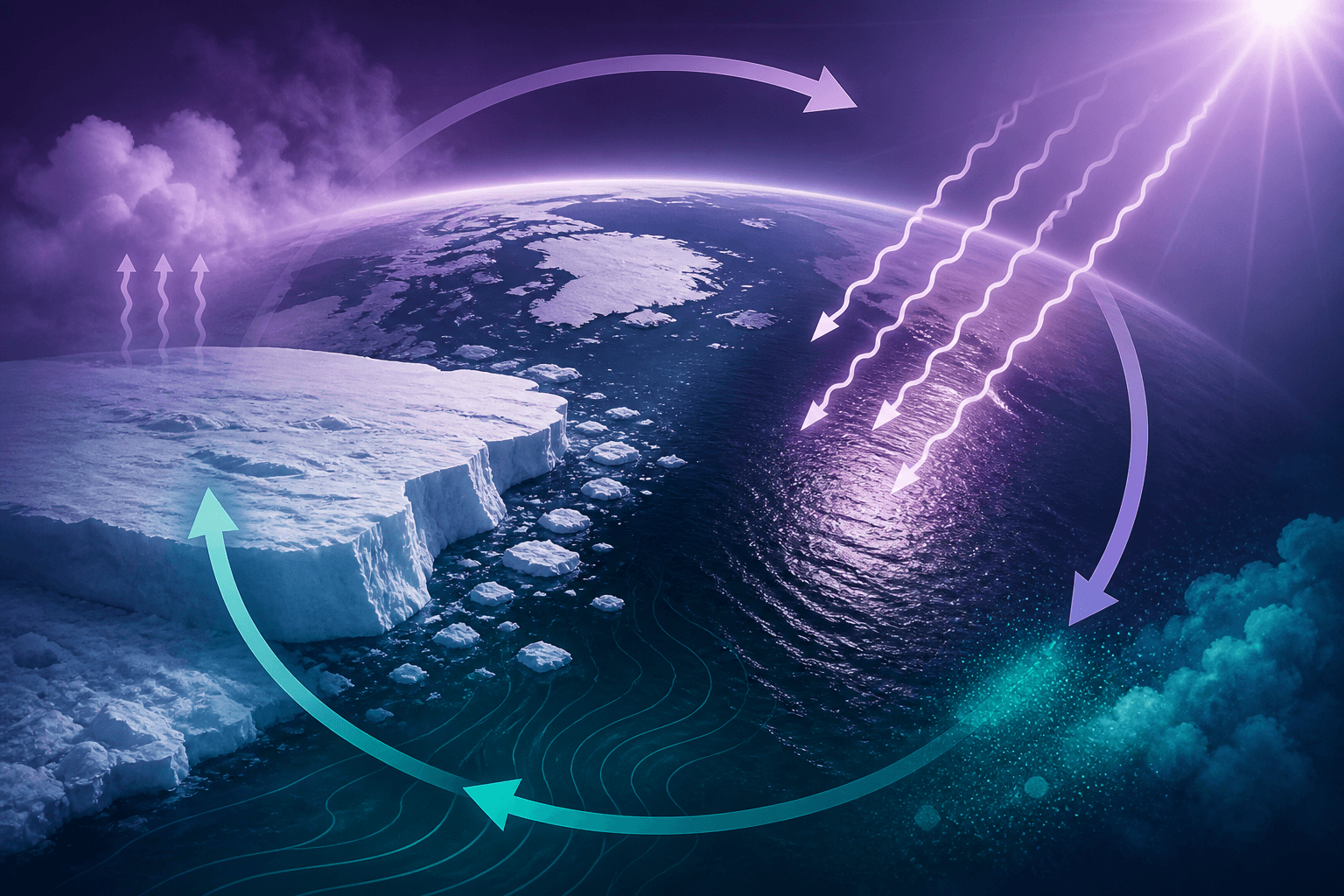
Climate is a coupled system: atmosphere, oceans, ice, land surface, and biosphere exchange energy and carbon. Feedback loops are processes that respond to an initial change and then either amplify that change or dampen it. Understanding feedbacks is how climate science explains why a modest initial warming from greenhouse gases can grow into a larger, long-lived shift—and why outcomes can be nonlinear without being mystical.
Forcing versus feedback
A radiative forcing is an external push on Earth’s energy balance—for example, rising carbon dioxide from fossil fuels and land-use change. A feedback is an internal response that changes the energy balance further.
Simple mental model:
External forcing (e.g., more CO₂)
        │
        ▼
 Initial warming
        │
        ├── Amplifying feedbacks  → larger warming
        └── Balancing feedbacks   → partial offset
        │
        ▼
 Net climate response
Climate sensitivity estimates summarize how much global temperature eventually changes for a given forcing, after feedbacks play out. Feedbacks are a major reason sensitivity is a range rather than a single exact number.
Amplifying (positive) feedbacks
Ice–albedo feedback
Snow and ice reflect a large share of incoming sunlight (high albedo). Warming melts ice, exposing darker ocean or land, which absorbs more solar energy, which promotes more warming and further melt.
Warming → less ice → lower albedo → more absorbed heat → more warmingThis feedback is especially important in polar regions and helps explain why the Arctic has warmed faster than the global average in recent decades (Arctic amplification)—a pattern documented across observational records and model experiments.
Water vapor feedback
Warmer air holds more water vapor. Water vapor is itself a greenhouse gas, so warming that increases atmospheric moisture tends to trap more heat. This is one of the strongest amplifying feedbacks in standard climate physics, constrained by thermodynamics (Clausius–Clapeyron relation) and by observations of humidity changes.
Permafrost and carbon-cycle risks
Warming can thaw permafrost and stress ecosystems, potentially releasing additional carbon dioxide and methane. These carbon-cycle feedbacks are an active research area: directionally concerning, with magnitude still being refined by field measurements and Earth system models.
Balancing (negative) feedbacks
Planck response
As Earth warms, it emits more thermal infrared radiation to space (Stefan–Boltzmann physics). That increased outgoing radiation is a fundamental balancing feedback that prevents runaway warming under ordinary planetary conditions.
Some carbon sink responses
Land and ocean sinks currently absorb a substantial fraction of human CO₂ emissions. Vegetation growth can increase under certain conditions (within limits), and the ocean dissolves CO₂—though ocean uptake also drives acidification, a separate impact pathway.
Warning: Feedbacks do not mean outcomes are unknowable. They mean the system can respond nonlinearly. Uncertainty ranges are a feature of careful science, not a license for dismissal.
Clouds: the hard middle
Clouds both reflect sunlight (cooling) and trap infrared (warming). Different cloud types, altitudes, and regions produce different net effects. Cloud feedback remains one of the larger sources of spread across climate models. Progress comes from satellite records, process studies, and high-resolution modeling—not from treating “clouds are uncertain” as a conversation stopper. Uncertainty about magnitude is not uncertainty about the greenhouse effect itself.
Why timing and thresholds matter
Some feedbacks strengthen as warming proceeds. Ice loss, ecosystem transitions, and ice-sheet dynamics can involve thresholds where recovery is slow on human timescales. That is why policy delay is not merely “the same warming later.” It can raise the chance of entering states that are harder to reverse with the same toolkit.
Public health links are direct: heat extremes, air quality, vector ranges, and food-system stress all track the broader climate trajectory. Feedback literacy helps explain why early emissions reductions have outsized long-term value.
How scientists constrain feedbacks
Researchers combine:
- Paleoclimate archives (ice cores, sediments) for past warm and cold states
- Satellite and in situ observations of ice, humidity, radiation, and carbon fluxes
- Physical theory (radiation, thermodynamics, fluid dynamics)
- Climate models that encode known processes and are tested against observations
When models disagree, scientists dissect which feedback parameterization differs—an empirical research program, not a vibe contest.
Local weather is not the global energy budget
A cold winter in one city does not cancel planetary energy imbalance any more than a hot afternoon “proves” a model. Climate refers to long-term statistics of weather. Feedbacks operate on that planetary energy budget and on regional systems that emerge from it. Communicating this distinction reduces false “gotchas” that confuse short-term variability with forced change.
Human systems as part of the loop
Land-use change, aerosol emissions, and greenhouse gases are human-driven forcings; agriculture, cities, and health systems then experience the climate response. Some adaptation measures (for example reflective surfaces, wetland restoration) interact with local energy and carbon budgets. Those interventions should be evaluated with the same forcing-versus-feedback clarity: what is the direct effect, and what secondary responses follow?
Limitations
This article is an educational overview. It does not replace IPCC assessment reports or regional impact studies. Local weather is not the same as long-term climate; a cold week does not falsify global energy-balance physics. Exact tipping-point timings for every subsystem remain uncertain even when directional risks are clear. Carbon-cycle and cloud feedbacks especially deserve ongoing measurement rather than overconfident one-line summaries.
Takeaway
Amplifying feedbacks help explain why greenhouse forcing yields substantial warming; balancing feedbacks explain why the planet still reaches a new energy balance rather than infinite runaway under present physics. The practical message is prosaic and evidence-based: reduce the forcing early, because feedbacks can make late action face a harder system.